On the Currency of Egalitarian Justice, and Other Essays in Political Philosophy by Otsuka Michael Cohen G. A
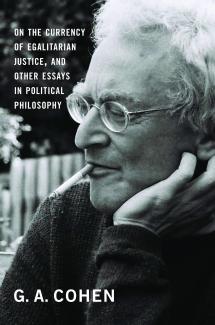
Author:Otsuka, Michael, Cohen, G. A.
Language: eng
Format: epub, pdf
Publisher: Princeton University Press
Published: 2011-06-02T04:00:00+00:00
2. DWORKIN ON OPTION LUCK
The foregoing reflections have implications for the question that forms the second part of my title.
According to Ronald Dworkin, justice requires some sort of initial equality of distribution, but certain inequalities are nevertheless just, some of them being those inequalities that result from option luck, or gambles, against a starting point of equality. Option luck, Dworkin believes, preserves justice, but brute luck overturns it. Dworkin distinguishes the two as follows: “Option luck is a matter of how deliberate and calculated gambles turn out—whether someone gains or loses through accepting an isolated risk he or she should have anticipated and might have declined. Brute luck [by contrast] is a matter of how risks fall out that are not in that sense deliberate gambles.”16
Dworkin does not specify the “sense” in which brute luck does not count as the result of a deliberate gamble, and a large critical literature has been generated by that lacuna. It will suffice, here, to convey what brute luck is by paradigmatic illustration: brute luck is illustrated by the case of a brick that falls on your head in a not particularly dangerous place.
Now, strong arguments have been advanced for the claim that, contrary to what Dworkin says, option luck against a just background does not always preserve justice, but does so at most under rather demanding conditions.17 I shall not explore that claim here, for the question, does option luck always preserve justice?, is not my question. My question is: does option luck (even) sometimes, or, in other words, ever, preserve justice? Or, more precisely, does it ever do so other than by accident, because it happens to replicate the pre-option luck distribution? In such a case justice indeed continues to obtain, but not because the outcome is a result of option luck, not because option luck has in a strong sense preserved justice, but simply because it happens not to have destroyed it. I shall mean ‘preserve’ in its stronger sense throughout what follows.
In order to pursue my subtitle question, I focus on a paradigm case of putatively justice-preserving option luck. I believe that, if option luck does not preserve justice in the case upon which I shall focus, then it never does, and we can then safely return a negative answer to the question that appears in my title. To anticipate, and bearing in mind the argument of Section 1, I am inclined to the view that option luck does not preserve the justice that renders the pregambling situation just.
Imagine, then, two people, A and B, who are relevantly identical with respect to their assets, their circumstances, their tastes, and so forth: they are, that is, identical in every respect that bears on distributive justice, and the distribution of goods between them is perfectly equal and perfectly just. Let’s say that each has $100,000. Now one taste that A and B share is for gambling. And each gambles half of his assets against half of the other’s, on a 50-50 toss.
Download
On the Currency of Egalitarian Justice, and Other Essays in Political Philosophy by Otsuka Michael Cohen G. A.pdf
This site does not store any files on its server. We only index and link to content provided by other sites. Please contact the content providers to delete copyright contents if any and email us, we'll remove relevant links or contents immediately.
| Anthropology | Archaeology |
| Philosophy | Politics & Government |
| Social Sciences | Sociology |
| Women's Studies |
The remains of the day by Kazuo Ishiguro(9000)
Tools of Titans by Timothy Ferriss(8396)
Giovanni's Room by James Baldwin(7346)
The Black Swan by Nassim Nicholas Taleb(7129)
Inner Engineering: A Yogi's Guide to Joy by Sadhguru(6796)
The Way of Zen by Alan W. Watts(6614)
The Power of Now: A Guide to Spiritual Enlightenment by Eckhart Tolle(5783)
Asking the Right Questions: A Guide to Critical Thinking by M. Neil Browne & Stuart M. Keeley(5775)
The Six Wives Of Henry VIII (WOMEN IN HISTORY) by Fraser Antonia(5515)
Astrophysics for People in a Hurry by Neil DeGrasse Tyson(5190)
Housekeeping by Marilynne Robinson(4449)
12 Rules for Life by Jordan B. Peterson(4305)
Ikigai by Héctor García & Francesc Miralles(4275)
Double Down (Diary of a Wimpy Kid Book 11) by Jeff Kinney(4272)
The Ethical Slut by Janet W. Hardy(4253)
Skin in the Game by Nassim Nicholas Taleb(4250)
The Art of Happiness by The Dalai Lama(4130)
Skin in the Game: Hidden Asymmetries in Daily Life by Nassim Nicholas Taleb(4007)
Walking by Henry David Thoreau(3962)
